Showing posts with label Other Things Literary. Show all posts

10.5.13

A Poem


Canons

The literary canon
keeps words in
a neat glass case.
My canon has
a greased black
mouth, launches
balls at all the
lonely boated men
in feathered hats.

10.4.13

Bone Road


Follow the rusty tracks down to my secret spot with Oliver’s shoes tucked under my arm. There’s no one’s footprints in the grass or the gravel, no one else that’s been here in my secret spot. Hear grass tickling in the wind and the wind pulling my shirt and tickling my hair, but nothing else. Turn down the bend and there’s Red Creek bubbling far away. Find Old Rusty where he’s supposed to be, leaning in the beach grass behind the red storage house. Water’s tapping on his coppery roof. Walk to him and look in through the empty windows and kick my foot against his slumped tires. Old Rusty. Pieces of driftwood still bed around the car—all the ones found along the beach that looked like bones. They curl like fingerbones and armbones with knots like elbows and knuckles. Drop Oliver’s shoes on the driver seat and kneel in the grass to look at my bones. No one’s been here. The bones are still crisscrossed.
            Open the door. It creaks like a voice.
            Hello?
            Take out the box under the seat and open it. The moldy pacifier. The rattle. The bib. The little tin boy dragging the blanket—it used to hang in the Christmas tree. No one’s been here. Drop the shoes in the box. Close the lid and slide the box under the seat and sit down in the seat with my hands around the steering wheel. Shut the door and hear the little voice creak before the door clicks shut. Look out the window, down at the bones circling the car like a white road, like they pass under. Water’s dripping on the roof, dripping like a faucet, dripping like the faucet. See the bathtub now, like it’s out the windshield. See the water coming up over the white shiny edges and spilling to the floor, and the faucet still dripping. The bones are moving faster under the car. Look into the passenger seat, say: Where do you want to go, Oliver? But he can’t answer and the water keeps dripping.

8.4.13

A Pixelated Fawn

I'm taking a writing class this term called Process Response—and it's awesome! We write and write and never look back. We have little groups to share our writing with. That's it. The point is to write in whatever form we are interested in and think about the process of writing and write about writing and never revise. The point is to move forward, disconnect ourselves from our own expectations and standards.

I've set myself up with only one restriction: I can only use this class to work on my novel. So far It's got me going places I didn't plan on going. Here's a little sampler of today's work (and what has been an inspiring photo by Myoung Ho Lee):


Up the long path of water into the woods there’s a fawn curled against the base of a rock, the thin hide of its back formed to its bedding in the underbrush. A hiker comes up the draw from the highway, his breath loud in the forest. He pauses when he spots the animal and waits for it to stir. He takes his phone from his pocket and snaps a photo, shades the daylight from the screen and looks at the image—the tan curvature lost in the fern. He walks again, slowly, phone held out like a crucifix. Something snaps under his boot and the sharp whipcrack startles him. He stops and looks down at the broken stick in the dirt, then quickly up the draw so as not to miss a vision of the fawn as it bounds through the forest. But the fawn hasn’t moved. It’s back keeps curled to him, face hidden somewhere among its folded limbs. The hitchhiker stiffens. He coughs, claps his hands awkwardly around his phone, whistles and listens to the forest swallow the sounds. Other, stiller noises replace his—the wind continuing its work through the trees, the water chattering anathemas beside him. And the fawn doesn’t move. He keeps his eyes on its spine as he inches away, down the draw. He is afraid to turn his back to the rock until it’s out of sight. He turns then and paces down the rest of the draw. When he comes to the trail, he finally slows to a walk.
         Back on the highway, he climbs into his truck and slams the door shut. He starts the engine and while he waits for it to heat up, he glances at the thick entrance of the forest where things bloom imperceptibly over the trailhead, clenching the path in fronds and dark shadows of fronds. A flock of swallows darts out from the treetops, black and scattered like buckshot against the sky. He watches them flee through the canopy. His phone sits brightly in his hand and he looks down at it, at the image there, the pixelated lump in the underbrush. Revving the engine, he erases the picture and tosses the phone away from him, onto the passenger seat. Then he lurches, tires crunching, down the road. 

17.12.12

Writer's Fever


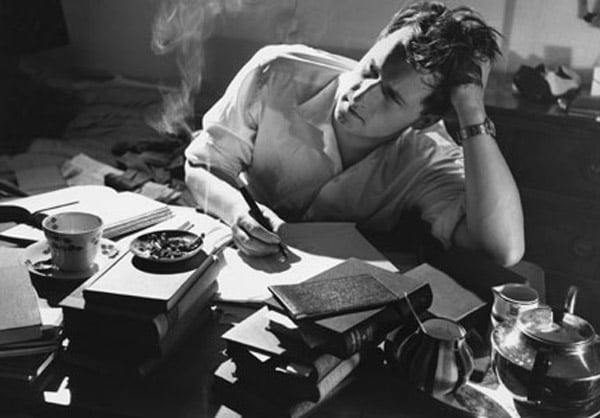
Been doing a lot of writing lately—not here, obviously, but hopefully that'll change. Nope: the kind of writing that makes you stare at walls for a good hour or three. What I need to do is find the perfect routine—something here inspires. No rules but to write. I wonder what this guy does when he's about to clack away on his Olivetti Lettera. I wonder what she would say if I asked her how to bloom.


13.12.12

A Return

Been away for awhile, overrun with studies—read a good deal of detective fiction, saw many a noir, read and reread Roland Barthes, Paul de Man and the likes. There was some Shakespeare in between. Now I'd like to get back here and keep steady.

So...

I'm two books deep in my winter reading: 


The most strangely paced novel I've read. A near four-hundred pages of toil. When events begin to bubble up, you buckle down, expecting the arrival of a game-changing plot point. But Hamsun resists. He opts for a quietness that seems impossible to sustain. Yet you never want to set the book down. It's beautiful, and like the only other novel of his that I've read—Mysteries—it's completely singular.


I've read Philip K. Dick before—he's so strange and hard to refuse. This is considered by Time Magazine to be one of the 100 greatest novels in the English Language. Pretty impressive. I can say this: you never know where he's taking you and you're never sure if things are as they seem. PKD's world is at once funny and scary—in Ubik, the living communicate with the dead (those suspended in half-life, a state between death and the great unknown), which is creepy, but his characters are also comically plagued by the money-grubbing gadgets of their time, never able to open doors in their own homes without paying up. Ubik is, simply put, a page-turner. Read it.

27.9.12

What's in the box?

Go ahead, push it! I dare you.

Well, I've been gone for quite some time. Not really...like a day, two, I think, but it feels much longer. It's not my fault though—I started school this week! This fall promises to be one of mystery and intrigue, as I have enrolled in both Detective Fiction and Film Noir of the 1940's


Today I spent the morning with this fine chap (the one on the right...well...I guess both of them, technically). We watched The Maltese Falcon, and like, man—that movie never gets old, man. I did enjoy hearing some newbies try to hash out (in excited whispering) just what was going to happen in the end. But, man, they totally got MacGuffed!


Among other things, I've ingested and digested The Murders in the Rue Morgue, Silver Blaze, The Adventure of the Devil's Foot, A Scandal in Bohemia and The Greek Interpreter. Sherlock Holmes, you rock! (No. Not you, Sher-lame!) Now I'm cracking the spine of Agatha Christie's first Miss Marple mystery, The Murder at the Vicarage. These are the exciting reads. I'm dreading The Intentional Fallacy and The Death of the Author—which might sound like murder mysteries, but are actually literary criticism. 


I forgot to mention Shakespeare—does that ex-nay me from English Major eligibility? Yep. Topics in Shakespeare—a pretty general course, four of his plays set in Italy. Pretty cool focus. I'm in the middle of Romeo & Juliet and should probably stop writing this post so that I can get back to homework. 

Soon soon! Happy Thursday!


19.9.12

Welty VS. O'Connor

C and I decided last night that Eudora Welty and Flannery O'Connor—though like minded and of the strongest southern piquancy—could only be distinguished by one rating system: 

Cool-ass VS. Bad-ass.


Here she is, in all her splendor. Eudora Welty. Have you met her? You should. Welty is definitely cool.  Too cool for school. Too cool for full-length pants. Too cool for a proper desk. Her vision of the American South reflects just such a coolness. 

Even in the midst of that slight apocalyptic feeling that she unravels her readers with—burn everything in the house cause we gave our only clothes to the garden to keep it warm!—she still handles her characters with sincerity and tenderness. She's equal parts portentous and endearing. You'll love watching her world unfold, even if the experience becomes, at times, jarring or down-in-the-dumps. 

Then there's Flannery O'Connor...

  
Just look at her. Flannery could be Eudora's best friend—heck, her cousin!—but don't drop your guard for a second. Where Eudora might tiptoe into the dark, Flannery straps on a pair of combat boots and goes for a waltz. She's not cool. She's bad. Hell's Angels would look for a detour just to get around her without having to look her in the eye.

What makes her so bad? O'Connor never really lets anyone off the hook—even the reader feels like some squirming animal trying to wriggle its tail out from under her foot. She deals, heavy-handed, with the soul. With faith and doubt and consequences. She deals in sweltering, gothic symbols. There is never really anywhere to hide and always always always there's the sense of something lurking in every direction. Read A View of the Woods or The Turkey. Heck—read 'em all. But be sure to keep the light on.


5.9.12

The Professor's House

I found it almost unbearable to consult my writer's gut about reflecting, pen-wise, on Willa Cather's The Professor's House. Like Death Comes for the Archbishop, this quiet novel eludes any classic form of literary criticism—the impression is too shifting, too flexible. To understand it is to feel it, first and foremost. 


And feel it you will—as long as you don't resist the places Cather wants to take you. It is a novel that requires entry to the pit of the stomach, to the stem of the brain, and what it leaves cannot be traced. For that reason, I'll simply express my undying love, gratitude and reverence for a novel that ultimately breaks the peripheries of the written form—a piece of pioneering in its own right.

Please, with all sincerity, read it.

28.8.12

Any last words?


I have a wretched habit. I read read read, dig into a story, crave the proper delivery of a tale—but my fingers always claw their way to the final page, so that I might sneak a glance of a book's last line long before I finish. I can't help myself. 

Often it's entertaining to see where an author will take a story, how the narrative will reach that final climactic moment when the reader slaps the book shut—or slowly lets the pages close back upon themselves, depending on the mood—and breathes deeply.


I spent some time with the bookshelf today, flipping through some of my favorite books, and I've come up with a short list of excellent last-liners. These are some of my favs—in no particular order. See if you can figure out where they came from (there's a list at the bottom if you get stumped). What are some of your favorite last lines?


1. For some minutes, before she fell into a deep, dreamless sleep, she just lay quiet, smiling at the ceiling.

2. The waves broke on the shore.

3. He says that he will never die.

4. It was "My Darling Clementine," a good song. 

5. Today, Kavalerov, is your turn to sleep with Anichka. Hurrah!

6. And silently they walked on, arms linked, holding each other tightly.

7. We were alone with the quiet day, and his little heart, dispossessed, had stopped.

8. She looked up and across the barn, and her lips came together and smiled mysteriously.

9. Eusabio and the Tesuque boys went quietly away to tell their people; and the next morning the old Archbishop lay before the high altar in the church he had built.

10. After Passover he became a Jew.

11. And somewhere the stinging smell of burning leaves. 

12. At last he made Charley understand that he wasn't supposed to talk to him.

13. The old man was dreaming about the lions.

14. It was the devious-cruising Rachel, that in her retracing search after her missing children, only found another orphan.


1. Franny and Zooey — J.D. Salinger  2. The Waves — Virginia Woolf  3. Blood Meridian or the Evening Redness in the West — Cormac McCarthy  4. Gringos — Charles Portis  5. Envy — Yuri Olesha  6 Mysteries — Knut Hamsun  7. The Turn of the Screw — Henry James  8. The Grapes of Wrath — John Steinbeck  9. Death Comes for the Archbishop — Willa Cather  10. The Assistant — Bernard Malamud  11. The Magus — John Fowles  12. The 42nd Parallel — John Dos Passos  13. The Old Man and The Sea — Ernest Hemingway  14. Moby Dick — Herman Melville

21.8.12

Hasta luego — El final de mi carrera españolas (posiblement)

Seeing as the end of Summer Term fast approaches—and my sanity is beginning to sink like a tar smothered 19th century Nantucket whaleship—I've decided to commemorate my long history of Spanish tinkerings by devoting it an entire post here on Tiquismiquis.

For several weeks now I've been reading Gringos by the southerner Charles Portis—who also wrote the better-known True Grit. I've been struggling to find time for this masterpiece of aimless wandering, but not because of any lack of interest. 

Portis is an incredible weaver of dry wit and stripped language. I've followed the rambling American expatriate Jimmy Burns from Mérida to the Mayan ruins, endured the onslaught of quirky characters and ever-shifting locales, and have just ended up in the middle of some bizarre hippy sacrifice. Still have 80 or so pages to go, but the adventure thus far has been otherworldly!


Wifey and I plan to accelerate our Friday night with a bottle of mezcal and—perhaps perhaps perhaps—some delicious Mexican food. I didn't know it at the time, but years ago I drank Scorpion Mezcal—including the butt-end of a withered scorpion. Apparently tequila can be considered mezcal, but mezcal cannot be considered tequila....?... The trick is in the extraction.

A heap of Agave

This weekend promises to be una gran fiesta y un largo descanso! Perhaps Sunday will present itself as yet another opportunity to see John Turturro do his do-rag thang! Until then, I've got three more days of language barriers, perfect tenses, presentations, examenes y pruebas. 


15.8.12

Don't look back (even you, Bob Dylan!)

Been thinking a lot about the A Bao A Qu, the first creature described in Jorge Luis Borges' The Book of Imaginary Beings.

What varmints stand your hair on end?
Borges chronicles the fable of a sort of listless blob, which camps out at the base of the Tower of Victory in Chitor. One can not see the creature when first ascending the massive spiral staircase that wraps around the tower, but the A Bao A Qu senses all humans, conscious as it is "to the virtues possessed by human souls." 

With each step of the visitor, the A Bao A Qu grows more defined and the passage of the climber literally breathes life into the once dormant creature:
"When a person climbs the stairs, the A Bao A Qu follows almost on the person's heels, climbing up after him, clinging to the edge of the curved treads worn down by the feet of generations of pilgrims."
I shrink at the thought of a staircase stalker. Borges' entry reminds me of growing up with a dark basement where the concrete laundry room could never be seen in full view—a room of corners, shadows, dripping pipes—and the oil furnace would kick on like backfire from an old pick-up truck. I avoided an entire third of my childhood house because of fables like this, and I'm sure I'm not the only one.

You know that feeling: both hands gripping the laundry basket, light from the top of the staircase burning down on you, cutting sharp wedges out of the darkness. You try to peer into that void space—if you've got any guts—but you still can't see anything, at least not by way of eyes. The imagination is a whole different story.

I'd be okay the first two or three steps. The sprinting would inevitably follow and the remainder of my journey would be spent trying to hold onto the laundry basket while resisting the force of gravity that wanted to see my teeth eat the stairs. 

To tell you the truth, I haven't gotten any better at conquering that fear—only better at hiding it.

Borges never tells us outright whether the A Bao A Qu really seeks the blood of its visitors, but my ominous stair-climbing history tells me, first and foremost, run.